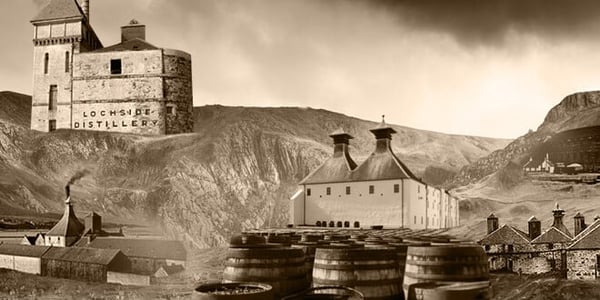
Distilleries:
Banff
(S)
1863 - 1983, Demolished
Ben Wyvis (H)
1965 - 1946, Demolished
Brora
(H)
1819 - 1983, Dismantled
Caperdonich (S)
1898 - 2002, Silent
Coleburn (S)
1897 - 1985, Dismantled
Convalmore (S)
1893 - 1985, Dismantled
Dallas Dhu (S)
1898
- 1983, Silent
Glen Albyn (H)
1846 - 1983, Demolished
Glenesk (H)
1897 - 1985, Demolished
Glen Keith (S)
1957 - 2002, Silent
Glenlochy
(H)
1898 - 1983, Demolished
Glen Mhor (S)
1892 - 1983, Demolished
Glenugie (H)
1831 - 1983, Demolished
Glenury Royal (H)
1825 - 1985, Demolished
Hillside (H)
1897
- 1985, Demolished
Imperial (S)
1897 - 2000, Silent
Inverleven (L)
1938 - 1991, Silent
Kinclaith (L)
1958 - 1975, Demolished
Ladyburn
(L)
1966 - 1975, Silent
Linlithgow (L)
1753 - 1983,
Demolished
Littlemill (L)
1772 - 1994, Demolished
Lochside (H)
1957 - 1996, Demolished
Malt Mill (I)
1908 - 1960, Dismantled
Millburn (H)
1805 - 1985, Demolished
Moffat
(L)
1965 - 1988,
Demolished
North Port (H)
1820 - 1983, Demolished
Pittyvaich (S)
1975 - 1993, Demolished
Port Ellen (I)
1825 - 1983, Dismantled
Rosebank (L)
1840 - 1993,
Dismantled
St. Magdalene (L)
1753 - 1983, Demolished
Malts:
Glencraig (S)
1958 - 1981, Dismantled
Glen Flagler (L)
1965 - 1985, Dismantled
Mosstowie (S)
1964 - 1981, Dismantled
Killyloch (L)
1965 - 1970, Dismantled
Grains:
Ben Nevis (H)
1955 - 1981, Dismantled
Lochside (H)
1957 - 1996, Demolished
Garnheath (L)
1965 - 1986, Dismantled
Moffat (L)
1965 - 1988, Demolished
Dumbarton (L)
1938 - 2002, Silent
Blends:
Lochside (S)
1958 - 1981, Dismantled
________________________
(L) - Lowland
(I) - Islay
(S) - Speyside
(H) - Highland
Silent - May be re-opened…
Dismantled - Buildings still exist…
Demolished - Gone for ever…
|
| The Lost Distilleries of Scotland
We often get asked "What should we collect?" and we often answer "How about the lost distilleries of Scotland?".
In the 1800's there were over two hundred distilleries in Scotland, but by 1945 the poor economic and political circumstances of the previous three decades had taken their toll and around seventy of these had closed. After the war, sales of whisky increased virtually every year until 1980, but for the next few years sales dropped dramatically, leaving a whisky surplus and, inevitably, this led to the closure of many more distilleries by 1984.
When we look at the distilleries which closed during the 1980's, the question always arises as to why those distilleries were chosen for closure? The answer lies somewhere between economics and politics.
Until the late 1980's most of the whisky being sold around the world was blended scotch. Single malts were not really important and were very small in terms of volume sales.
Hence, when cuts needed to be made during the slump, distilleries producing whisky which had little flavour impact in blended scotches were shut down, especially in cases where the size of the distillery was small or where the distillery was located in a remote part of Scotland. In turn, the capacity at the larger more economical distilleries was increased.
Little did anyone know that single malts would become a phenomenon and that a new style of consumer looking for a diversity of tastes and flavours would seek out the different single malts from around Scotland in the hope of finding Whisky Nirvana. |
| There is currently stock available from around thirty "Lost Distilleries", with prices for most of these increasing with every new release. The question to ask is which will disappear first. It is very difficult to know how much stock from each of these distilleries is still out there, and sometimes we only find out when it's too late. We remember selling Kinclaith about 10 years ago for £30.00 / bottle, but next thing we knew Gordon & Macphail had no stock left. The price for this product increased to £500.00 / bottle very quickly; recently there have been new releases of Kinclaith, but nothing at less than £600.00 / bottle. |
 |
Currently, our biggest sellers in this category are Brora, Killyloch, Lochside, Port Ellen, Rosebank & St.Magdalene (Linlithgow).
With the huge rate of sales of these whiskies, we expect them to
disappear over the next 4-5 years.
Other distilleries worth keeping an eye on are Glenury Royal, Glenlochy & Glenugie. These are all great drinking malts, usually with very few disappointments. They are mostly released from independent bottlers and are always a pleasure to try. |
Lost distilleries may have done little for the flavour in blended whiskies, but demand today for these unforgotten heroes is high and increasing everyday. Consumers are discovering the elegant, sweet, floral Lowlanders including St. Magdalene (also known as Linlithgow) & Rosebank, the easy drinking fruity Highland malts like Glen Albyn & Glen Mhor, and the more powerful, peaty, smoky Port Ellen from Islay.
Naturally, not every bottling from these "Lost Distilleries" will be good and as drinkable as some of the others. We feel that any product released by the distiller or brand owner is always respectable, but the bottlings from some independant bottlers can vary dramatically.
|
|
| Even though we try and chose the whiskies we offer for sale carefully it is sometimes not possible to try every bottling: we must also rely on the reputation of the bottler. It should really be their responsibility to select casks for bottling with care, however this is not always the case nowadays. As casks from Lost Distilleries are getting more and more difficult to find, some bottlers feel they do not have a choice but to bottle what they find, while they still can. |
In 1993 United Distillers (now Diageo) closed 4 more distilleries including Rosebank, which, being a Lowland distillery, was of a style that was of little importance for blended whiskies. Since it was not part of the "Classic Malts" range, it was also closed. Many have asked why Rosebank was not chosen as part of the "Classic Malts" range, as it is possibly a better and a more true style Lowland whisky. The answer is simple: Rosebank was located on the banks of the Forth-Clyde Canal at Camelon, on the outskirts of the industrial town of Falkirk. On the other hand Glenkinchie is near the pretty village of Pencaitland and the view is of green picturesque countryside with rolling hills, the perfect setting for any distillery. |
 |
| Diageo, the owners of Rosebank have recently bottled the last of the Rosebank 12 year old under the "Flora & Fauna" series. We know they still have some aged stock and will release a 25 years old with a distillery label in the next few weeks. |
|
A distillery that most of us have discovered only in the last 10 years but many have yet still to discover is Brora. Located in the north east of Scotland opposite Clynelish distillery, this is one of the most interesting distilleries in Scotland, yet very little is known about it. This distillery was originally called Clynelish, but in around 1967 a new distillery was built across the road which was also called Clynelish. We believe that casks from both distilleries were marked as Clynelish for a year or so until the Scotch Whisky Association asked for the name of one of these distilleries to be changed. The old distillery was then renamed as Brora.
|
 |
We find many different styles of Brora and we believe the company records are not clear as to why this is - or maybe the information is there but now that Brora has a cult following they feel it should remain a secret. There are both heavily peated and lightly peated styles, sometimes both from the same vintage. We also find heavily sherried versions which again gives a different whisky. The older vintages from the early 1970's are the ones which have challenged even the peatiest Islays, but sadly these are now getting more and more difficult to find. |
| We still have stocks of the official bottling of Brora 30 years old from Diageo; there has been an annual release since 2002. It is rumoured that this years release (2007) may be the last, but we are still waiting for clarification. We believe that all six of these releases include a high proportion of vintages from the early 1970's, if you know these vintages you can certainly taste them in the 30 year olds. |
Demand for Islay malts is very high and has been for the last few years, and we feel this is something which is set to last. Demand for Port Ellen has also been high but we know that Diageo still has some stock and will release another two or three bottlings over the next few years. The previous six releases have been excellent, with the last release (2006) selling out in a few weeks.
It is nice to see that they have maintained very fair prices - the last release was £125.00, but it would have sold just as well at £200.00. We have recently secured some more stock and our current price is £149.00, but I am quite sure stocks will not last long and prices will increase further. The 1st release from 2001 started life at £110.00; today we sell this at £349.00. |
 |
|
There are also some casks still with Independent bottlers, but with the speed of sales I cannot see these lasting too many more years. Also, with every new release we see an increase in price: the average price of a cask strength Port Ellen today is about £100.00 - it was £50.00 about 5 years ago.
Over the next few months, we will be adding further information on all "Lost Distilleries" in the distillery profile section of the website.
This section will be updated as we get more useful information on "Lost Distilleries".
|
|
Sept. 2007
Sukhinder Singh |
|