


 United States — would you like to set this as your default country of delivery?


 Trade
Trade  Shops & Events
  Customer Service
 A Global Guide to Sparkling Wine Styles
All you need to know on sparkling wine, its production, and key sparkling wine styles, from Champagne to Prosecco and more


New Africa - stock.adobe.com
The pop of a cork under high pressure, the sound of bubbles settling in a glass – wine tends to feel more celebratory when it’s sparkling. And while it gets much of that celebratory reputation from the most widely known (and arguably best-loved) sparkling wine in the world, Champagne, there are examples from across the world, from France to Italy, the USA and more.
How is sparkling wine made?
From Champagne to Prosecco and far beyond, the biggest distinction between sparkling wines is in their production method. All sparkling wines will have undergone an initial fermentation (as with any still wine), before undergoing a second round of fermentation where more yeast, sugar and nutrients are introduced under airtight conditions. This lets the carbon dioxide, which is unable to escape, manifest as bubbles in the finished wine.
This secondary fermentation provides the basis for all sparkling wines, no matter their style or price point, but there are a few methods available to producers – most notably the traditional method, the charmat method and the ancestral method.
Champagne and the traditional method
The traditional method (also known as the méthode champenoise, the méthode cap classique, or other variants) was the first to be finessed – as the story goes, by the Benedictine monk Dom Pérignon, who in the late 17th century pioneered secondary fermentation in individual bottles using a cork closure.
In Champagne and other traditional-method sparkling wines, the approach has changed relatively little since it was popularised in the years since. After the blend of still wines has been assembled and the secondary fermentation has begun in the bottle, individual bottles are left to age long after the yeast has turned all of the added sugar into carbon dioxide, usually sloping 45 degrees downwards, with the dead yeast cells still present. They’re ‘riddled’ (or turned) regularly, often by hand, to prevent the yeast from settling, and when a bottle is deemed ready to be released it's disgorged, with the yeast cells being ejected from the bottle by a rapid freezing of the neck, and often with a small amount of sugar solution known as dosage added for flavour and texture.
In recent years, some technological advancements have increased efficiency of some parts of the traditional method’s process: gyro-palettes have taken much of the work out of riddling, and disgorgement can be done as part of a bottling line. Beyond that, though, there’s not a huge amount of opportunity to mechanise the process any more than it already has been, and the manual labour and time associated with the traditional method is one of the reasons the resultant wines can be more expensive than charmat-method sparklings.
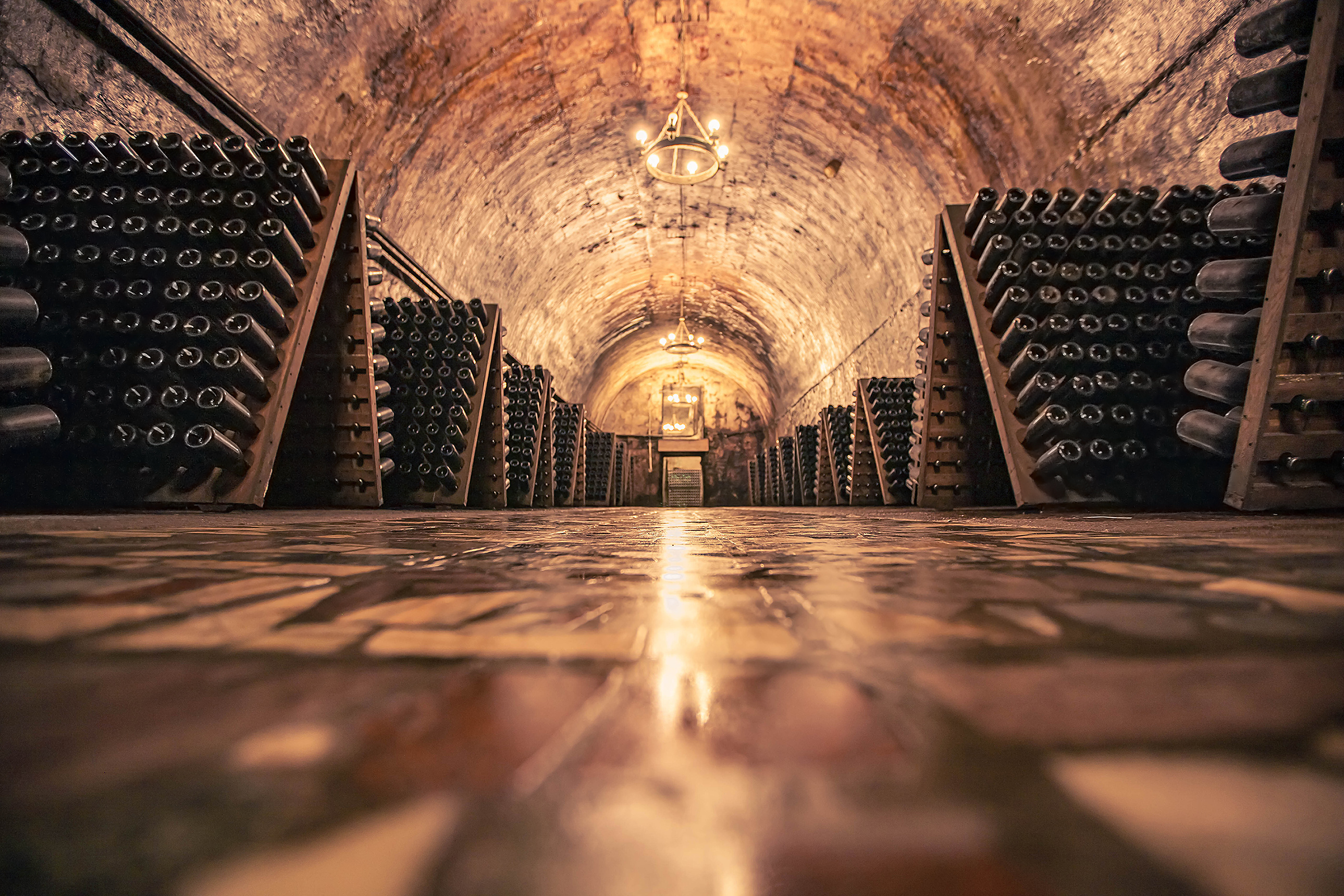
Today, the traditional method is a non-negotiable of Champagne production and is also widespread across the world. Champagne-method sparkling is a fixture of the winemaking landscape, including other regions in France, where it’s known as crémant and produced notably in Bordeaux (Crémant de Bordeaux) Burgundy (Crémant de Bourgogne) Alsace (Crémant d’Alsace), the Loire Valley (Crémant de Loire) and more.
Elswhere, the traditional method is also used for the vast majority of English sparkling wines, as well as in Spain (for Cava), Italy (for Franciacorta and other sparkling wines), the USA, South America, South Africa and plenty more besides. Many of the sparkling wines from these countries have also borrowed other winemaking practices from Champagne, including long lees ageing, late disgorgement (allowing richer and fresher flavours and longer ageing potential after release), with many of them producing sparkling wines made with the three hero grapes of Champagne – Chardonnay, Pinot Noir and Pinot Meunier.
Like in Champagne, many of these wines will be created using the current year’s harvest as the ‘base vintage’ and blending it with ‘reserve wines’ held back from previous years before the secondary fermentation, while others will be made using a blend of grapes from a single vintage. Each region covered by a protected geographical indicator, like that of Champagne, may insist on specific production methods as well as the grapes permitted to be used. Either way, the best sparkling wines from around the world are generally made using the traditional method.
Read more about Champagne production in our guide to Champagne here
Prosecco and the charmat method
Champagne was at one point such an exemplar of the category as to be practically synonymous with sparkling wine more generally. However, recent years have seen another, very different region bring its hero product to the forefront for many drinkers: Prosecco. Named after a small village and legally made only in the northern Italian regions of Veneto and Friuli-Venezia Giulia, Prosecco has been made for generations, but has captured the attention of many sparkling wine drinkers in recent years for its fresh fruit notes and its affordability, as well as being the basis for Italian long drinks including the Spritz and the Negroni Sbagliato.
The fundamental difference is that Prosecco is made using the charmat method (or Metodo Charmat-Martinotti). Also known as the metodo Italiano or tank method, this technique for making sparkling wine was pioneered first by Federico Martinotti in Italy in the late 1800s, and then later refined by Frenchman Eugène Charmat, who patented it in 1907.
Instead of the second fermentation occurring in individual bottles over a relatively long time, the charmat method involves assembling a blend of still wine in large, airtight steel tanks, then adding sugar and yeast to kick off the secondary fermentation. As with the traditional method, this forces the carbon dioxide produced to form bubbles in the wine, but because of the scale and speed of this carbonation, the resultant sparkling wine can be bottled much quicker and more efficiently.
In simple terms, this is why Prosecco and other wines made using the charmat method sparkling is usually relatively cheap, but generally less complex in flavour than Champagne and other traditional-method sparklings. Other wines made using the Charmat method include Lambrusco, sekt wines in Germany, and a handful of other styles in countries around the world.
Pétillant-naturel and the ancestral method
A style that has also found increasing popularity in recent years – especially alongside the emergence of so-called ‘natural wine’, is pétillant-naturel. Often shortened to pet-nat, these are lightly sparkling wines made by the ancestral method, or méthode ancestrale.
As the name might suggest, this is the oldest method for producting sparkling wines, and as its other name the méthode rurale hints at, it's also the most rustic. In simple terms, a winemaker allows their wine to ferment to a certain point, and it is bottled while there is still viable yeast and sugar to feed on. While in the bottle, this first fermentation will continue, but now under pressure, which typically results in a lightly sparkling wine with some residual sugar and sediment.
In order to ensure that fermentation continues in bottle, the use of sulphur has to be absolutely minimal, and while it would technically be possible to filter the wine before bottling, there generally isn’t the time to do so. This can result in a wine with great texture and uninhibited flavours, while it can also mean a relatively large amount of variation from bottle to bottle in terms of sweetness, pressure and flavour profile. This is something that’s anathema to the majority of Champagne and sparkling wine producers – who will generally value consistency within an individual cuvée or house style, and market themselves accordingly – but they can appeal to a younger and more curious audience looking for unfamiliar and unconventional flavours.
Traditional examples in this style are wines like Clairette de Die, which makes full use of aromatic varieties for a gently sparkling, sweet wine full of bright fruit flavour. More contemporary examples are not limited by variety or region, and styles can vary tremendously ranging from relatively clean and fresh mineral styles to more yeasty and creamy examples, through to pet-nats that would be hard to distinguish from cider thanks to some prolonged skin contact, One thing that does unite them is a surprisingly savoury, saline note – a result of the yeast sediment.
Sweet sparkling wines
Regardless of which production method they use, many sparkling wines can be released in a sweet style.
The addition of dosage after disgorgement is commonplace in Champagne and other traditional-method sparkling wines, used by winemakers to round out their final wine adding richness but not rendering the finished product perceptibly sweet. However, the fashion for dry Champagne is a relatively new one, and for much of its history, wines were topped up with dosage to an eye-watering 250g of sugar per litre, which is roughly equivalent to a Sauternes. These styles are still produced and are labelled in order of sweetness, from demi-sec and sec to doux.
With Prosecco and charmat-method wines, there tends to be some sweetness inherent to the style, which compliments the riper fruity notes of the wine. To achieve this, the winemaker will adjust the amount of sugar used to trigger secondary fermentation, and then halt the fermentation when the required alcohol levels have been reached, leaving behind suitable levels of sweetness.
Another process used to create a sweet sparkling wine is the Asti method. Taking its name from Moscato d’Asti, a much-loved Italian wine, it involves pressing grapes before the juice is introduced into a pressurised tank, where fermentation begins. Once the wine has achieved a relatively low level of alcohol it is chilled, filtered and bottled under pressure for a gently sparkling sweet wine.