


 United States — would you like to set this as your default country of delivery?


 Trade
Trade  Shops & Events
  Customer Service
 A Guide to Springbank
While there are many cult distilleries in Scotland, unknown to most drinkers but loved by their fans, there is one that surpasses the rest – The Jewel of Campbeltown: Springbank.

These days, Campbeltown is a quiet town. However, it was once the bustling heart of the Scotch whisky industry, with more than 30 distilleries dotting its streets. Overproduction, variation in quality and the fickle whisky market's downturn in the 1920s all took their toll, so for most of the 1900s only two distilleries remained: Springbank and Glen Scotia. While the more recent renewed interest in Scotch whisky has helped revive the town's fortunes somewhat (with three distilleries now in operation and at least another three being planned or built), it is Springbank that has caught the limelight.
The History of Springbank
The Mitchell family settled in Campbeltown in the 1660s and laid down solid roots in the area, working in a number of businesses, including malting. In 1825, Archibald Mitchell became a partner in the Rieclachan distillery along with his brother Hugh, having previously run an illicit still nearby. In 1828, Archibald’s in-laws purchased the site where his still had been and founded a new distillery, Campbeltown’s 14th: Springbank.
Archibald’s sons, John and William, bought the distillery in 1837, and the official connection between Springbank and the Mitchells began. It was not only the Campbeltown distillery in the family, with Archibald’s sister Mary building Drumore and William leaving Springbank to build the original (of which more later) Glengyle. With William gone, John’s son Alexander joined the company and J&A Mitchell was born.
By the early 1900s, Campbeltown’s boom was reaching its peak. However, with the fallout of the Pattison Crash in Scotch whisky and then the inter-war years leading into the great depression, Campbeltown’s distilleries closed. Glengyle survived until 1925, but with the closing of Rieclachan in 1934, only Glen Scotia and Springbank survived.
Springbank continued despite the adversity and by 1970 the whisky market had recovered enough for the distillery to add a heavier style of spirit to its portfolio, the heavily peated Longrow. However, this recovery was short-lived and the lean years of the 1980s, when distilleries closed across Scotland, led to intermittent production. Things started to shift again in the 1990s and Springbank rose with the tide, adding a lighter style of spirit: the triple-distilled Hazelburn.
In 2000, with the market looking healthy, J&A Mitchell bought the site of William Mitchell’s old Glengyle distillery and in 2004 opened a new Glengyle, home of (for various trademark reasons) Kilkerran whisky, itself named after another closed Campbeltown distillery.
One distillery, one maltings, three spirits
Springbank, Longrow and Hazelburn are released under their own labels, and their fans don’t necessarily crossover with each other – the three spirits are all quite different and distinct.
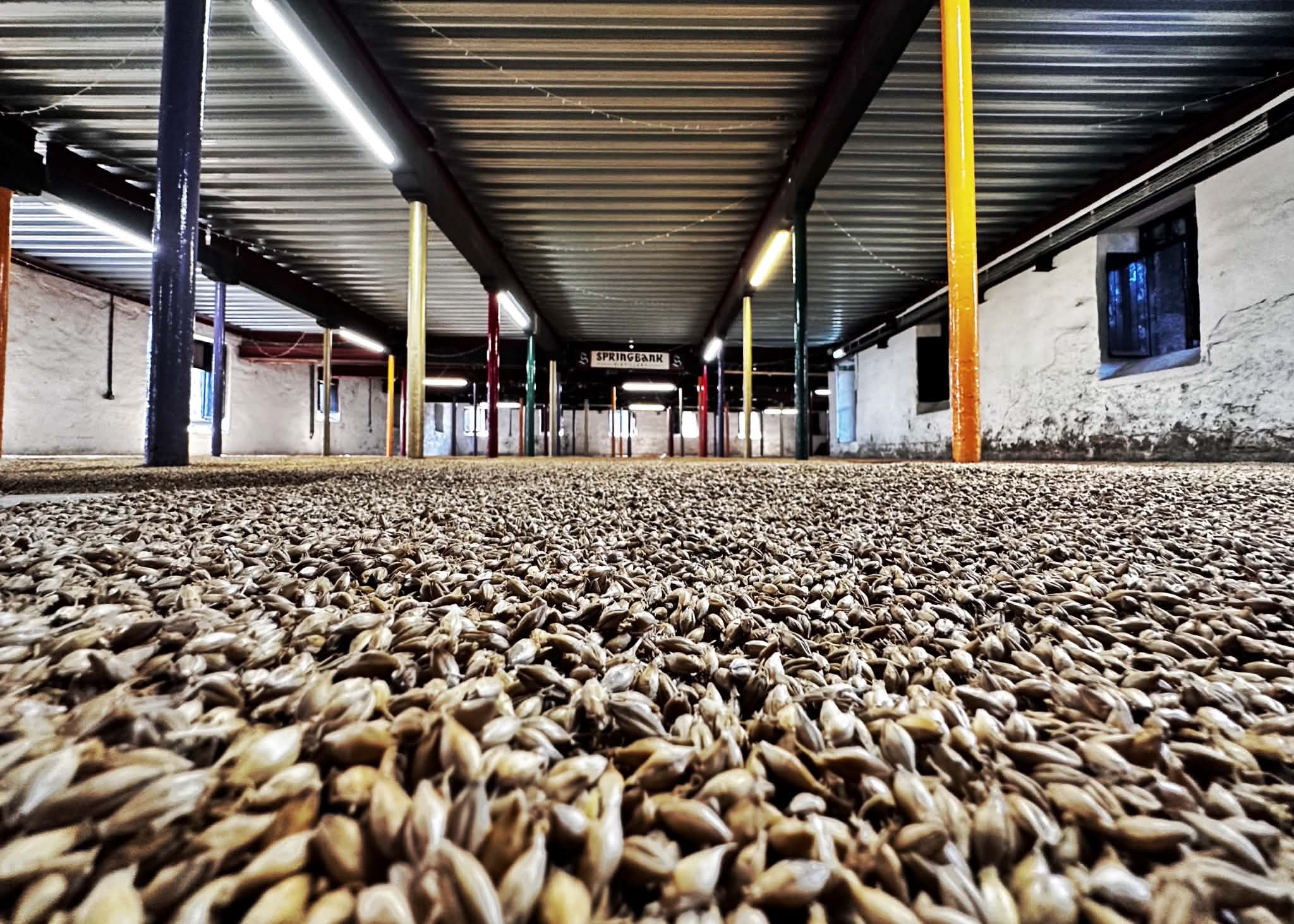
It all starts from the grain. Springbank is one of the few distilleries which malts all of its own barley using traditional floor maltings. This is a labour-intensive way of producing malt, with workers shovelling grain around by hand and then monitoring it carefully to catch its development at the right moment to be perfect for whisky making. While it is expensive and time-consuming, it does give the distillery full control over the process, including how much peat smoke to add during malting. The result is three distinctive whiskies:
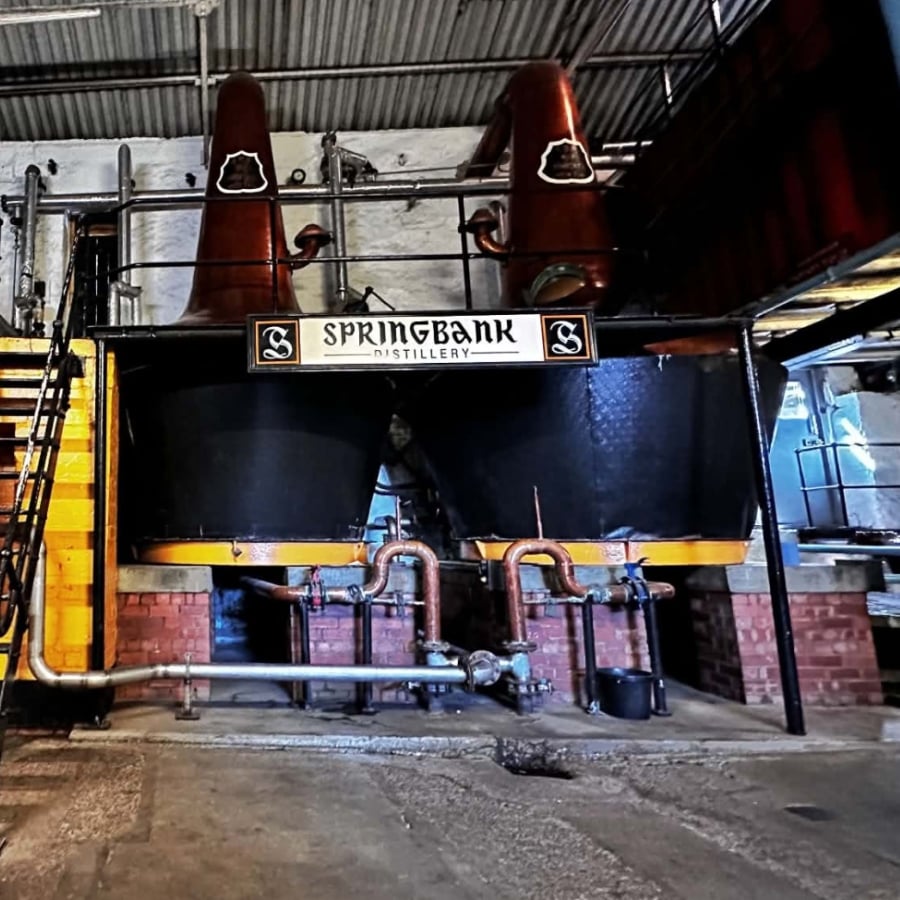
Springbank: a slightly farmyardy whisky with soft smoke. For this style of spirit, the distillery uses both a smoky peat fire and clean hot air to dry the malting barley, giving it a medium level of smoke. It’s distilled ‘2.5’ times, moving spirit around in different proportions between three stills to create the final Springbank new make in a process that hasn’t changed for decades.
Longrow: a heavily peated whisky that is very much a relative of the spirits produced over on Islay. The barley is dried just using a peat fire, giving it an intense smokiness. Add to that a simpler double distillation process, and you get something that’s a bit weightier, smokier and more intense than Springbank.
Hazelburn: the antithesis of the other two whiskies: lighter with a creamy character. This comes about thanks to no peat being used to dry the barley and the spirit being triple distilled. This extra distillation gives a more polished and delicate spirit than Springbank and Longrow, which matures into a more elegant and delicate whisky.
The distillery’s core range
While the distillery’s annual and special releases are the most sought-after by drinkers and collectors, the distillery’s core range of whiskies doesn’t stick around on the shelf either. These bottlings are produced in small batches and land in shops fairly regularly, with a little bit of variation between releases – generally between very good and outstanding. If you’re really concerned about which batch you’ve got, every bottle has a laser code printed on the glass which you can compare with other releases.
Springbank 10 Year Old
Springbank 10 Year Old is the heart of the core range and the whisky that most overtly shows off the distillery’s quirky character. Hints of mulchy straw and hay, along with bright orange, honey and toffee notes are complemented by soft smoke and a bit of brininess. Classic Springbank and an excellent starting point.
Springbank 15 Year Old
For those who like their whiskies a little richer than the 10-year-old, Springbank 15 Year Old is the go-to in the range. Matured solely in sherry casks, it adds layers of dried fruit and spice on top of the 10-year-old's brighter notes, along with tobacco leaves and leather from the extra five years of maturation.
Springbank 5 Year Old 100° Proof
The latest arrival in the range, Springbank 100° Proof has been divisive. Some fans love its 100%-bourbon-cask maturation and youth showing off the raw distillery character underneath, while those who prefer the tempering influence of sherry or time haven’t been quite so keen. Whatever your opinion, its punchy 57.1% ABV gives an intense hit of Springbank character and is well worth a try. It’s also the whisky that’s usually easiest to find at the moment.
Longrow Peated
The singular entry in the core range of the distillery’s big and smoky make. Longrow Peated is matured in a mixture of bourbon and sherry casks and is designed to be a showcase of what Longrow can do – a centre line that other releases can veer off from. It’s big and smoky with a balance of creamy custard, dried fruit and spice.
Hazelburn 10 Year Old
Hazelburn 10 Year Old is the counterpoint to Springbank 10 Year Old, taking a different approach to flavour while still part of the family. It’s matured solely in bourbon casks to let the spirit character develop without being swamped by the rich dried fruit flavours of a sherry cask. The result is a creamy and fruity whisky with a touch of the tropical.
Springbank’s Special Editions
Springbank is legendary for its limited-edition releases. These pop up regularly, from annual releases to special series and bottles commemorating events:
Annual releases: not officially considered part of the core range, but popping up fairly regularly are the older age statements: Springbank 18 Year Old, Springbank 21 Year Old and Springbank 30 Year Old. These are only made in small batches and are snapped up quickly
Springbank 12 Year Old Cask Strength: originally an easy-to-find, regularly available whisky, each batch now flies off the shelf. Each release is slightly different, with different cask recipes occasionally giving very different results. Usually, it is focused around sherry casks, but recent releases have seen rum casks in the mix and even a 100% bourbon cask in 2025.
Springbank Local Barley: once a legendary series of 1960s' vintages, Springbank’s Local Barley range was revived in 2016 as a yearly release of whisky made using barley grown by local farmers. Its character varies from year to year, based on cask choice, age and the barley variety selected.
Longrow special editions: The smoky spirit is not overlooked, with Longrow 18 Year Old, Longrow 21 Year Old and Longrow 100° popping up from time to time. They may not be quite as coveted as their Springbank equivalents, but you need to be quick to get hold of them.
Visiting Springbank
Campbeltown is a special place, and Springbank sits at its heart, both literally and figuratively. It’s not a big town and the distillery is fairly central. More critically, when the owner of Mitchell and Sons, Hedley Wright, passed away in 2023, he left the company to the people of the town, and it is still one of the biggest employers in the area. Visiting is often one of the easiest ways of getting a chance to try rare expressions of Springbank, with the distillery bar having many interesting bottles open, but the logistics of doing so are more complicated than it at first seems.
Campbeltown sits at the end of the Kintyre peninsula, and while it is only about 60 miles from Glasgow as the crow flies, the route by road is 140 miles and takes more than three hours to drive. If you don’t have a car, there’s a bus from Glasgow that takes four hours. For those who don’t like sitting still for a long time, there are regular flights from Glasgow airport that only take 45 minutes (plus several hours of check-in, security and travelling to and from the airport…).
However you get there, it’s a magical place and a match for Springbank – idiosyncratic and different from its peers, but well worth the effort to experience.


