


 United States — would you like to set this as your default country of delivery?


 Trade
Trade  Shops & Events
  Customer Service
 Debunking regionality
Scotch whisky regions shape how we talk about flavour, but do they really explain what’s in the glass? Here, we examine where Scotch whisky regions came from and why flavour is better explained distillery by distillery.

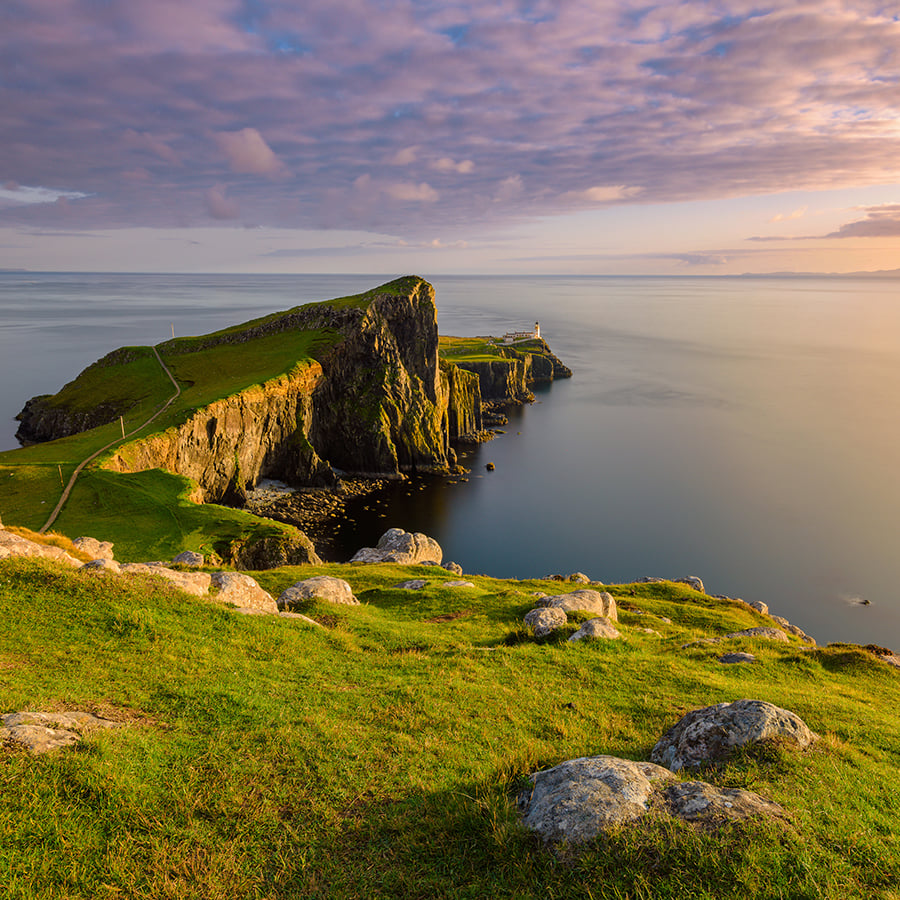
The rugged Scottish coast
Scotch whisky is divided into five legally defined regions: Lowland, Highland, Speyside, Islay and Campbeltown, but how best to speak about them and use them to tell a flavour-led story of Scotch whisky?
Scotland can be divided geographically/geologically: the boundary fault which divides Low-Land from High-Land and the archipelagos of the west and north; and culturally – the linguistic division between these two zones, Gaelic in the Highlands, Scots/English in the Lowlands. The third element, and the one which is most relevant in creating this idea of whisky regionality, is politics.
The Highland Boundary Fault runs in a long diagonal from the north of Arran to just south of Stonehaven on the east coast, a fact which was drawn upon in 1784 by the British Government as it tried to exert economic control over whisky production. You could also argue that the division was part of the post-Culloden remaking of Highland Scotland – whisky regions becoming part of a colonialist project.
The result was Lowland and Highland distillers operating under different tax regimes and production specifications which in turn fed into the rise of illicit production (which we’ll look at some other time).
Interestingly, the line didn’t follow the geological fault, but was defined by county. The ‘Highlands’ comprised Orkney, Caithness, Sutherland, Ross, Inverness, Banff, Nairn, Moray, Aberdeen, Kincardine, Forfar and Argyll. (Perth, Stirling, Lanark and Dumbarton were excluded the year after).
In 1797, an ‘Intermediate Area’ was created with yet another duty rate. Although two years later a Parliamentary Report recommended that, as the Line had failed to stop the smuggling of illicit whisky, it should be abolished, it only ceased to exist in 1816.
The recent interest in regions comes with the rise of single malt and how the category's modern (re)birth drew heavily from wine. When it came to defining the current whisky regions in 2009, the opportunity existed to use geographical rather than political boundaries. Instead, the new Highland boundary, ‘…means the line beginning at the North Channel and running along the southern foreshore of the Firth of Clyde to Greenock, and from there to Cardross Station, then eastwards in a straight line to the summit of Earl’s Seat in the Campsie Fells, and then eastwards in a straight line to the Wallace Monument, and from there eastwards along the line of the B998 and A91 roads until the A91 meets the M90 road at Milnathort, and then along the M90 northwards until the Bridge of Earn, and then along the River Earn until its confluence with the River Tay, and then along the southern foreshore of that river and the Firth of Tay until it comes to the North Sea.’ Which is, in effect, the original tax line of 1784.
It also means that the whiskies from the islands (bar Islay) are all ‘Highland’, and that distilleries in the geographical Lowlands – Loch Lomond, Glengoyne, Deanston, Tullibardine, Strathearn, Aberargie, Fettercairn, Glencadam and Arbikie – are now Highland.
The story becomes even more tangled when you look at Speyside. If, as the moniker suggests, Speyside is defined by the river, it would make sense if the boundaries were dictated by valley and watershed. Instead, ‘Speyside’ consists of: ‘(i) the wards of Buckie, Elgin City North, Elgin City South, Fochabers Lhanbryde, Forres, Heldon and Laich, Keith and Cullen and Speyside Glenlivet of the Moray Council as those wards are constituted in the Moray (Electoral Arrangements) Order 2006(b); and (ii) the Badenoch and Strathspey ward of the Highland Council as that ward is constituted in the Highland (Electoral Arrangements) Order 2006(c).’ Politics again.
While a wine-like model was rejected for regional boundaries, it was drawn upon when firms began to try and link whisky regions to flavour: Lowland whiskies were gentle because of the landscape, Islay’s were all smoky, Highland drams were rugged, Speyside’s were (somehow) elegant.
It’s a tempting theory, but does it hold water (or whisky). Does each distillery from north of Glasgow to Harris and Shetland taste the same?
In Speyside, can you say that Dufftown’s six distilleries: Glenfiddich, Balvenie, Kininvie, Mortlach, Dufftown and Glendullan taste the same? One of the most fascinating aspects of Speyside lies in its diversity of flavours. In the region, you run the gamut of whisky flavours, from fragrant to fruity, malty to meaty – and even smoky.
Islay is often defined by smoke, yet not all Islay whiskies are peated – or use Islay peat. The closer you look, the more exceptions to the rule there are, until the rule itself collapses.
To find the origin of today’s regions you have to look at the rise of blended Scotch in the late 19th and early 20th century. Blenders used broad-based groupings often driven by geographical location to create flavour camps – so Islay meant heavy smoke, Campbeltown meant heavy/oily, North Country was lower smoke and more fruit. Widening the flavour options was the key to what became regionality, but importantly what the blenders didn’t want was homogeneity within these camps – Ardbeg still had to be different to Lagavulin, Linkwood not the same as Mortlach. Individual distillery character was vital.
The broad differences in regional flavours can also be explained by a combination of geography, production and transportation, something which was revealed in 2024 with the publication of ‘The Distillation of Whisky’ by independent bottler James Eadie. A compendium of articles first published in 1927, the book gives a comprehensive detailing of how whisky was made in this era. The relevant part for regionality lies in the section on yeast.
In the 1920s, most distillers were sourcing their yeast from brewers. In simple terms, the further away the distillery was from the brewery, the less active the yeast was and the heavier the new make became. Lowland whiskies were lighter, those from the far north heavier, those whose yeast had to come by boat – Campbeltown and Islay – were the heaviest.
Transport was therefore also a driver – the ease or otherwise of getting coal/coke to the distillery reducing the need for peat, how long it took by road rail or sea to get yeast.
Perhaps we need to look at the concept in a broader way and try to reintroduce those building blocks of geography, geology, history and culture. All of these have impacted on a distillery’s location and how it makes its whisky. Location, transport, heritage, and climate all come into play, as does community. The challenges facing a distiller in the Western Isles are different to that of one in Fife. Not region, or terroir, but place.
Regions remain useful because they perform the function of saying whisky is made across Scotland, but discussing them is actually more complex – and fascinating. Any conversation about single malt should always be distillery and flavour first.